Tuesday, December 6, 2016

A Plague ‘O Both Your Houses!

“A plague o' both your houses! I am sped…
“A plague o' both your houses!
"They have made worms' meat of me.”
- Mercutio, Romeo & Juliet Act III Scene I. by William Shakespeare

In the last three years, I’ve been very fortunate in my health. With the exception of a brief stint with the norovirus two years ago, I’ve been able to shorten most of my colds to last under two weeks.

At the end of October, I got a particularly nasty version of the common cold that involves a sore throat, stuffy nose, and cough. But compared to what I’m used to getting it took me by surprise enough to speculate something serious.

During my self-imposed isolation, I worked from home four days in a row to avoid spreading the cold to my coworkers. During this self-imposed exile, I understandably started going a bit crazy and began referring to my cold as “the plague,” which led myself to exclaim “A plague ‘o both your houses” per Mercutio in Romeo and Juliet.

Despite my melodramatic statement (or rather, because of) my next thought went from Romeo & Juliet to the plague in general, and then specifically the Bubonic Plague that struck Europe from 1346-1353. Funny how my mind is never more than four or five steps from a historical reference.

Most of us have learned about the Black Death. Formally known as the Bubonic Plague, the disease spread from flea to rat to human that originated in Asia. When the disease came to Europe in the 14th Century it’s estimated that between 75 and 200 million people died by the end.

The topic of the Black Death is a huge one, but here are some things I find the most interesting about the Black Death:
  1. Nobody was safe - whether you were a peasant or a King, the Bubonic Plague struck
  2. It’s estimated that one-third of the population died as a result of this disease
  3. The entire class system across Europe was turned on its head.

I think this whole topic deserves a bit more attention, which I plan to give it! That and this entire blog to be honest - I’m aware that I’ve been horrible at keeping this updated, so I am hoping to bring this back in 2017 - probably with shorter and more succinct posts.

Happy History!


Sunday, May 17, 2015

RMS Lusitania


When you decide to immerse yourself fin history you never quite know what you’ll learn in the process. Maybe you want to learn more about your ancestral home, and you discover that you’re family lived in the same town in Italy where Napoleon was born. Perhaps you discover that your someone in your family was good friends with Paul Revere. Or perhaps you learn, as I did, that your family simply happened to travel among one of the most famous ships in history.

In my specific case I have a tie to the RMS Lusitania. My great grandmother emigrated to the United States with her family on the RMS Lusitania. This obviously happened sometime before May 7, 1915 because on that date the ship was torpedoed by a German U Boat and sunk, killing 1,198 passengers and crewmembers.

When the ship set sail on its maiden voyage in 1906 it was briefly the largest ship in the world. This boat was meant to be a passenger ship, and it boasted a spacious and comfortable interior. But really, history knows this ship for a completely different reason.

The Paris Declaration Respecting Maritime Law, established in 1856, codified the rules of engagements involving civilian vessels, granting all passengers and crew members of civilian ships safe voyages so long as they could be boarded and checked and did not transport any items of war.

In early 1915 the Germans began using submarines to attack naval vessels achieving occasional successes. In February of 1915 the North Sea around the British Isles was declared a war zone.

The Lusitania was nearing the end of her crossing bound for Liverpool from New York when she was struck. Unfortunately conditions made the usage of lifeboats difficult or impossible. Of the 1,962 passengers and crew 1,191 lost their lives.

Most who died were British and Canadians, but 128 American lives were lost, enraging the then-neutral country.

The Lusitania was sunk because the Germans believed the ship “carried contraband of war” and thus Germany had a right to destroy her regardless of the passengers. Germany was relieved of any responsibility of the 128 American lives because of the existence of “war zones.”

Despite the outrage felt by many Americans, it would take two more years for the United States to become involved in WWI. When Germany re-instituted their unrestricted submarine warfare in 1917 this event pushed the US over the edge and brought the country into the war. This event solidified the importance of submarines in modern warfare. While only one of the many ships sunk during the war, I suppose this stands out because of my own personal tie.

Happy history!

Wednesday, April 22, 2015

Second Battle of Ypres

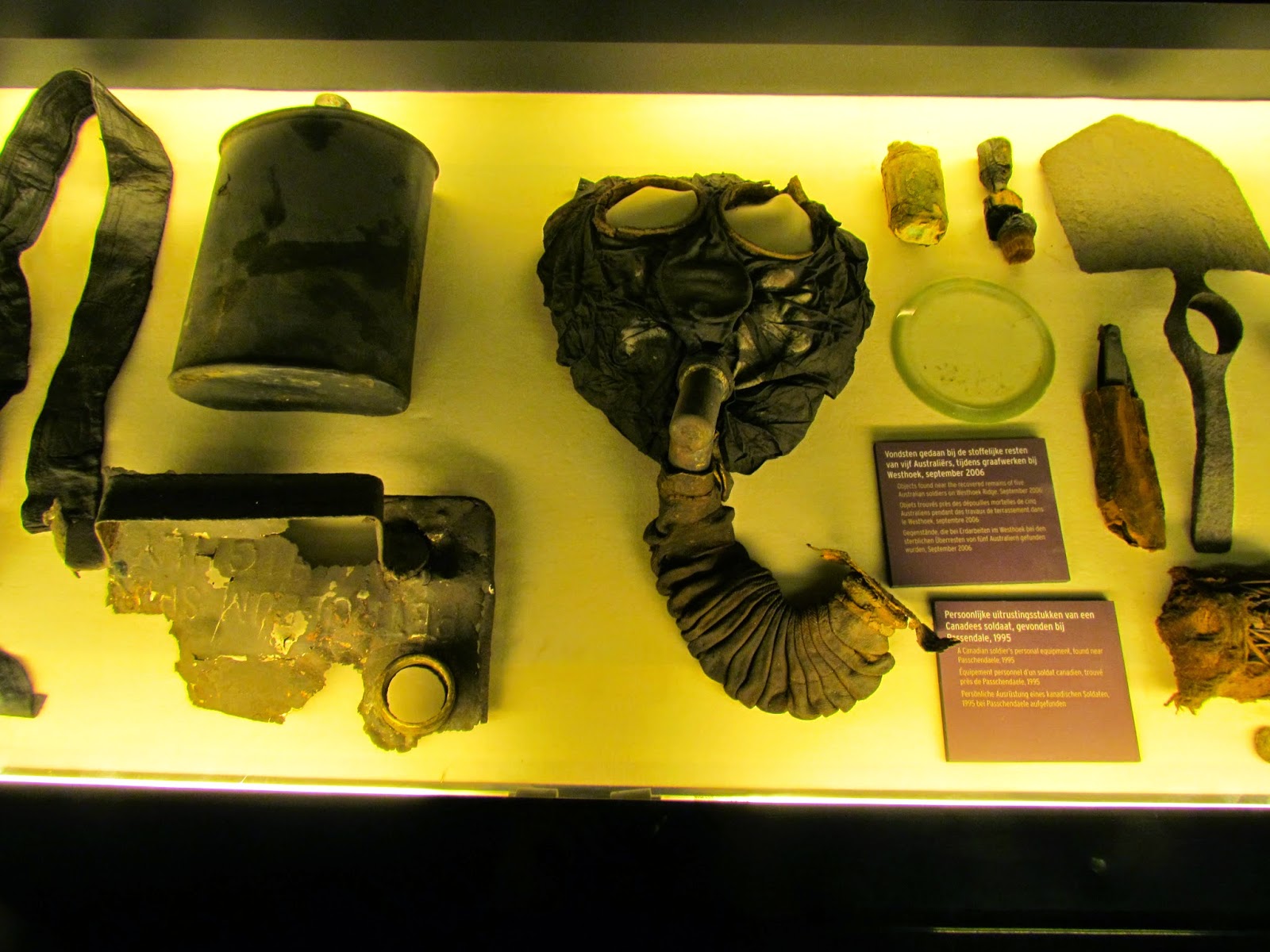
Gas mask on display at Tyne Cot Cemetery When I was on my WWI tour, the underlying theme was death and waste. This was the first modern war, fought with different tactics than in the past because of the advanced technology. At this point 100 years ago, both sides were in a long stalemate. There were skirmishes but nothing that resembled any sort of victory of one side or another. So to try to have a decisive victory the Germans decided to try something new. On April 22, 5,700 canisters containing 168 tons of chlorine were released. 10,000 French and Algerian troops were effected. Within the first 10 minutes, half of those men were dead. Unfortunately, the Germans failed to take advantage of their advantage and the Allies managed to hold most of their positions.

Two days later on April 24, a second gas attack against a Canadian division pushed the Allies further back. 5,975 troops were affected with 1,000 fatalities. The Second Battle of Ypres ended on May 25 with insignificant gains for the Germans. However this was the introduction of poison gas used as a military strategy, and this tactic would have great significance in WWI.

Last year when I took my WWI tour, I think a part of me forgot about the brutality and inhumanity of war. The theme of poison gas, and the sheer waste of human life quickly became apparent as the day wore on. Site after site featured rows and rows of headstones and walls filled with names illustrating the sheer volume of human death. Of this, the gas was probably the most shocking for me to experience.

In Ypres, which has since been rebuilt, there is a fabulous WWI museum that we were able to visit for a little over an hour. The whole day was very memorable, but one distinct memory that I have is from this museum, and it is regarding the use of the gas weapons for the first time. Using audio there were characters from both sides describing the situation, both leading up to and after the battle. During this account the death was described. Beyond human death, any living thing in the area was killed including insects and any rats living in the trenches.

Losses during the Second Battle of Ypres are estimated at around 69,000 Allied troops (59,000 British, 10,000 French), against 35,000 German, the difference in numbers explained by the use of chlorine gas.

Think about that account for a minute. Think about those numbers for a minute.

Gas was continuously used throughout the rest of WWI by both sides. While initially effective, by the end of the war sophisticated gas masks existed to protect troops and thus limited the effect the gas had for either side.

It’s hard for me to truly translate how astounded I was to learn what I did during that tour about the chemical gas. I think putting so much emotion into words is simply not possible. I keep coming back to the sheer waste of life that WWI was. In this way, the Second Battle of Ypres is important, if only so we can stop and think about those who lost their life during this battle.

Happy History
Canadian memorial dedicated to those servicemen who lost their lives during WWI.

Sunday, April 19, 2015

Concord and Lexington


On the morning of April 19, 1775, the American Revolutionary War started. It started outside of Boston, Massachusetts.

When I was in middle school I went to visit my Aunt out in Massachusetts. It was one of those family vacations that was long enough ago that I can’t quite remember all the details. To this day I can’t remember when exactly we visited or if there was a reason for our trip out east. More importantly, I think it was this trip that really solidified my love of history. The whole region has so much.

While I was there we took a tour of Paul Revere’s house, walked the Freedom Trail in Boston, and more importantly visited Concord and Lexington. And from what I remember, the experiences were truly amazing. I think they helped open my eyes to the power of history, of truly being able to connect those dots between the past and present. I remember being in Lexington reading the plaques and realizing the impact that the past action of a few men had a profound impact on my current life.

We’ve all heard the story: On the night of April 18, the British Army marched from Boston to nearby Concord to seize their weapons stockpile. Seeing the movements, a beacon was placed in Old North Church, which helped sound the alarm. From there Paul Revere rode out to warm the Minute Men yelling “The British are coming!” When the two armies met in Lexington fighting broke out

(I just learned a fact that really made me laugh a bit; a fact that had me edit what I typed above to include this fun nugget of historical learning. This is the fact that Paul Revere probably never yelled out “The British are coming!” as he rode out to sound the alarm. First, many of the British were hiding in the countryside so the operation was meant to be discrete (even in terms of 1775 timelines a man shouting “The British are coming!” was not discreet). Secondly, the colonists still considered themselves British at the time, so that probably wasn’t the exact phrase Mr. Revere used.)

At dawn on April 19, the British army of 700 came upon 77 militiamen outside of Lexington. After being ordered to lay down their weapons a shot was fired. To this day, nobody knows which side fired first. Several British volleys were unleashed and eventually order was restored. Eight militiamen lay dead on the soon-to-be-American side with nine wounded, and one Redcoat was injured.

The British continued into Concord to search for the weapons being stockpiled there (which had been relocated by this time) and decided to burn what little they did find. Militiamen occupying the high ground outside of Concord moved to Concord’s North Bridge, which was being defended y a contingent of British soldiers. The British fired first, but their fire was returned.

After searching Concord for about four hours the British prepared to return to Boston. But by this time almost 2,000 militiamen had descended to the area. They followed the army and engaged them. When the British column reached Lexington, it ran into an entire brigade of fresh Redcoats, but this did not stop the colonists from continuing their fighting.

What does this event signify? Perhaps I’m overemphasizing the American Revolution because I myself am an American, but we were the first country to seize the ideals for the Enlightenment and fight for them. From nothing, the men and women of our country have created something wonderful. America is revered as one of the greatest countries in the world. While we may be far from perfect, we have withstood 240 from that first day of fighting. Let’s come full circle from where I started – the actions of the men that fought 240 years ago shaped the country we are today. Without their actions, the present may have been very different indeed.

Happy History!

Wednesday, January 14, 2015

Badass Women in History: Eleanor of Aquitaine


Every day I go to work, sit in my cube and do what I think is important work. Occasionally I get in a slump where I wonder why I’m doing what I’m doing and if I’m making a difference. So today I’m going to start what I hope is an ongoing series to remind me that in the grand scheme of things I still could do something significant… here’s to dreaming!

This is a series I’d like to call Badass Women in History. In a world ruled predominantly by men, it’s easy to find information about them and their achievements. But women, they play a completely different role, play by a completely different set of rules, and often met a bloody end because of their influence.

Today I’m going to start off with someone everyone should know: Eleanor of Aquitaine. If you’ve heard the story of Robin Hood (and who hasn’t heard the story of Robin Hood) you know of Eleanor: she was the mother of King Richard I and King John.

Eleanor was born in 1122 or 1124 in Aquitaine, a region of France filled with wealth and prominence. At the age of 15 her father make her Duchess of Aquitaine, making her the most eligible heiress of France. So eligible in fact, that she was married to King Louis of France in 1137. She would have two children, both daughters with Louis.

As part of the marriage agreement it was decided that Aquitaine would remain a separate entity outside France until Eleanor’s first son reached majority, which helped solidify her power. Also showing her power was Eleanor’s decision to accompany her husband on the Second Crusade, it is even rumored she dressed as an Amazon.

In 1152 Louis and Eleanor’s disagreements reached a head and she was awarded an annulment. This was after she birthed two children, both daughters. They remained in France.

This is when Eleanor started looking for prospective second husbands, and her sights fell on Henry II. With a claim to the English throne, he seemed to be a good option, even though he was around 11 years younger. On December 19, 1154 Eleanor was crowned queen of England. At this time, England had claim to more land in France than the French King.

Her and Henry had eight children, five boys and three girls. Henry and Eleanor’s marriage was not easy; both were strong willed and both strayed from their marriage. Eleanor took favor to Richard and raised him in Aquitaine where she resided away from her husband. And in 1173 she even joined forces with her four oldest sons and attempted to overthrow Henry. The revolt didn’t work, and Eleanor was locked up until 1189.

Richard ascended the throne after his father’s death (and death of his three older brothers). While on the Third Crusade Eleanor ruled England as regent. Eleanor died in 1204, outliving all her children except John. She was close to 80-years old.

During the twelfth century women didn’t have much power, so for one woman to be queen of two countries, bare 10 children, and live to be close to 80, Eleanor didn’t do too badly for herself.

Thursday, December 25, 2014

Christmas on the Frontline

In 1914, five months into the Great War, for a few short hours the guns stopped firing on either side. This small act became known as the Christmas Truce.

On Christmas Eve, both lines sang Christmas carols from the trenches and on Christmas Day, the German troops appeared from the trenches saying Merry Christmas in their native tongues.

At first the Allies feared an attack, but seeing their foe unarmed they joined them in no-mans land. The men exchanged presents of cigarettes and plum pudding. There was even a friendly game of soccer (or football) played between both sides.

The so-called Christmas truce only happened in 1914 and this event was the last show of chivalry between enemies; a ceasefire during war was never replicated. Here we are 100 years later, and history would show that the Great War was not the war to end all wars. But on this single day I hope that all can reflect on the true meaning of this holiday: peace, love, and goodwill. May everyone regardless of religion have a truly wonderful day.

About a month ago this ad was circulating. It really depicts what occurred and speaks to what happened a hundred years ago. If you haven't had a chance to watch, it's a nice gesture today.

Saturday, November 22, 2014

First Battle of the Ypres: Oct 19 – Nov 22


When WWI first broke out, many thought that it would be a fast war that would be over by Christmas. Armies happily marched to war. Hindsight of the event would reveal a war that would last 4 years and kill millions of people.

The first major battle was what came to be known as the First Battle of Ypres (yes, there was more than one Battle of Ypres). Starting October 19th and ending on November 22, this battle lasted over a month, and both the German and British strategies are unclear. The accepted reasoning for the battle was the British desire to secure the English Channel ports and their supply lines. The French strategy was to prevent German forces from outflanking the Allied front from the north.

Ypres was the last major German option after their defeats at the First Battle of the Aisne (September 1914) and First Battle of the Marne (September 1914). The Battle of Ypres became the culmination of the Race to the Sea.

After four months of heavy fighting and casualties (750,000 German and 995,000 French), the German and Allied armies attempted a breakthrough operation to win a decisive victory. Ypres was strategically vital. It was the last geographical object protecting Calais and Bologne-sur-Mer, and the loss of these ports would have denied the Allies the shortest supply route. For Germany, Ypres was also strategically important; the collapse of its Ypres front would allow the Allied armies access to the flat terrain of Flanders.

I found it interesting to learn that at Ypres the British army provided the smallest number of men. Instead of providing forces, they saw their role similar to the Napoleonic wars: maintaining their dominance of the seas and providing financial support.

This battle was made up of several smaller battles. Being hugely complex, I’m only going to summarize the conclusion. The German Army, though the best in the world, was unable to gain a decisive victory. On both sides, the commanders struggled to come to terms with the power of modern weaponry and adapting their techniques. The battle also marked the superiority of the defensive strategy over the offensive strategy. In fact, it wouldn’t be until the Hundred Days Offensive in 1918 when the Allies would no longer take the defensive position.

Ultimately, at the end of the battle both sides were at a stalemate, where they would continue until 1918. This battle brought both armies to the end of the line, the ocean where they could no longer attempt to outflank one another.

As I said, there were several battles at Ypres, and the next will be very influential as well.

Happy History!

Sunday, October 19, 2014

The Flooding of the Ijzer Plain

Flooding near Yser, 1916

My WWI tour was really wonderful. I had the fortune to see things up close and personal, in addition to learning some new information. Our second stop on the tour was what has been dubbed “The Trench of Death.” This area is part of the Ijzer Plain, and it’s a preserved line of defense for the Germans. On October 19, 1914 the area was flooded to stop the German advances.

Time for some background on this event. Allow me to pull out the nifty handout I was given and I in turn insisted on bringing back with me.

In October the Belgian Army and the German Army were in a stand off over the Ijzer Plain. The Commander-in-Chief of the Belgian armies, King Albert I, calls on his men to preserve some land for Belgium against the German invaders. So the land was passed back and forth between the two sides.

What’s important to note at this point is the geography of the region: the land in this area is only a few meters above sea level. As my tour guide explained it, the Germans didn’t have great maps with them and they thought the region was actually several more meters above sea level than it was.

On October 16, 1914 the area was partially flooded to make sure the strategy would work. On October 19, 1914 the canals from the Yser River were opened and the area was fully flooded, restricting the German movement and effectively stopping their progress to the sea. The fighting switched from a war of movement to true trench warfare. The region remained swampy for the remainder of the war.

Now at the top of this blog I mentioned “The Trench of Death” and I thought (mistakenly) that this area was preserved because of the flooding that happened in October 1914. Well, as I continue to refer to my handy flyer, I realize that the Trench of Death is completely separate. So for that reason I’m planning to wait to post about it.

So now the meat of this short blog: why does this battle matter and why is it important? This small victory allowed the Belgians to remain control of a sliver of land and made King Albert a Belgian national hero. For us today, I think this victory is important to remember and know about. I certainly hadn’t learned about it before my trip and keeping the Germans from reaching all the way to the sea certainly helps give the Allie troops some advantage during this early stage of the war.

Happy History!

My image looking out of the Trench of Death. Notice how close the river is, and imagine how easily this area could become flooded.

Saturday, October 4, 2014

Plan XVII and the Battle of the Frontiers


In my notes from my WWI tour I have “look up French strategy/offensive.” I wrote this as I watched a video on the bus from Brussles to the German cemetery; I wrote it because I was taking notes during a movie being played on a history tour that I went on during my vacation.

Clearly I am the coolest person ever.

When I typed this simple term into Google, Plan XVII came up. And with it came the Battle of the Frontiers. This was the offensive strategy of France and the Allies at the start of WWI.

After the defeat of the French armies during the Franco-Prussian War of 1870-1871, the French military adapted to the new balance of power in Europe. With the growing strength of Germany, and the loss of Alsace and Lorraine to Germany, France had to react with it’s own plan.

Plan XVII developed from strategies prior to it, and essentially it called for increased military presence at the Franco-German boarder, with additional troops on the Franco-Belgian boarder. Luckily, General Joseph Joffre who drafted the pan saw a risk of German attack through Germany.

When Germany declared war, France executed Plan XVII with five initiatives. Collectively, this is known as the Battle of the Frontiers.

Battle of Mulhouse – Aug 7-10 Battle of Lorraine – Aug 14-25 Battle of the Ardennes – Aug 21-23 Battle of Charleroi – Aug 21 Battle of Mons – Aug 23-24

Essentially, all five were implemented as an offensive into both Alsace-Lorraine and Belgium. Essentially, in a few weeks the French were pushed back to their starting positions. The only reason that the Germans were halted is because they outran their supply lines.

In this same movie I learned that the Germans realized they needed to go on the defensive. So, the Germans began to dig in and create trenches. All the lines that I saw had one thing in common: the Germans had the higher and better ground.

Happy History!

Monday, July 28, 2014

July 28, 2014 – Beginning of the War to End All Wars


Here we are. We’ve made it to July 28, 2014. And if you paid any attention to my blog or your history classes you should know what’s coming next.

The war to end all wars, the Great War, World War I.

I thought there would be more as we got closer, but really there hasn’t been much made about this. And I find that sad from a historic perspective, as well as for the realiziation I’ve come to about this war.

I need to actually back up a bit.

The post date may say June 28, but I’m not actually posting this on this day (thanks for covering my ass technology). In actuality, I’m posting nearly a week later. Why?

For over a year it has been my dream to go to Europe around the start of WWI. I wanted to be on the continent on the day when this war broke out, a war that would change the map of Europe forever and culminate in nearly an entire generation’s death and cause three empires to crumble entirely. In anticipation I actually scheduled a tour of WWI sites in Belgium. I’m glad I did the tour before I posted.

Why?

This war was probably one of the most profound wars that is also overlooked. It lasted for four grueling years, resulted in 10 million military deaths, and nothing was accomplished. For four years men from around the world came to sit inside a trench and do nothing except occasionally gain an enemy trench and kill their “enemy” with cruel and astonishing proficiency. When the war concluded in 1918, the landscape of France and Belgium was completely destroyed, void of town that stood there and any natural elements. Craters existed where bombs had exploded, or mines were dug into the ground.

What I saw on my tour were two very opposite things. First was the sheer volume of death. 10 million is a huge number, but to visit cemetery after cemetery, see the 300,000 names of those who were missing in action, presumed dead, and never identified, and really realize just what a waste the war was on life is profound. The sheer scale goes way beyond what you can understand when you read some numbers on paper. The second thing I saw was life: towns have since been rebuilt, trees now inhabit the previously barren no mans land, and life has moved on.

As my last post addressed, the powder keg was the Archduke being assassinated. However, it wasn’t until this day that the Central Power countries did anything. Think about that, over a month had passed before Austria made a decisive move.

On this day in history the Austro-Hungarians fired the first shots in preparation of the invasion of Serbia. Let’s back up just a bit; prior to this date, the Austria-Hungary delivered an ultimatum to the Kingdom of Serbia in response to the murder of Franz Ferdinand and declared war. Austria hoped the Germans could help deter Russia from being engulfed in war. Serbia replied to the ultimatum on July 25, but rejected two of the demands. Austria served diplomatic relations and ordered partial mobilization.

It was William II of Germany who pushed for war. He instructed the German Foreign Office to tell Austria-Hungary there was no longer justification for war and it should temporarily occupy Belgrade. I think also that it can be safely assumed that Austria-Hungary is equally responsible – the leaders probably wanted to prove they were still relevant as an Empire, and wanted to assure their dominance on the continent. The next day war was declared and the artillery began to bombard Belgrade.

At this point the international alliances formed over the previous decades were invoked. Russia ordered partial mobilization against Austria-Hungary.

So, on this day the first shots were fired. What happened next?

Germany no longer believed the conflict could be “localized” to the Balkans, so on July 31 they sent a 24-hour ultimatum requiring Russia to halt its mobilization and an 18-hour ultimatum requiring France to promise neutrality in the event of war. Both countries ignored these demands. So, on August 1 Germany ordered war against Russia and France ordered general mobilization.

As Russia mobilized (which we know always takes them time to do) Germany seized the moment. On August 2 they asked neutral Belgium if they could come through the country to France. Belgium said no, because it was a neutral country. So, on August 3 and 4 Germany invaded Belgium and Luxembourg before moving towards France, leading Britain to declare war on Germany for breaking Belgium’s neutrality.

Well, what ended up happening was that Germany made it into Belgium, but they got bogged down there from Belgian resistance. The Germans were unable to make it to Paris (per the Von-Schlieffen plan) and the result was a series of battles knows as the race to the sea where the two parties tried to out-flank one another until they hit two land barriers: water and mountains. The trench warfare that pursued was really a 4-year stalemate between the powers.

I’m not even close to being done posting about WWI. I not only have four more years of moments to capture, but a few more that I would like to post about on their 100 year anniversary (among other things). So for now I leave you with this, but expect more to come.

Happy History!

Saturday, June 28, 2014

The Powder Keg


Every conflict has that defining moment. It can be big or it can be small. With WWI, it was both. But I think it’s the lead up that that made the moment so big. For years Europe had been going through transition. Areas like the Holly Roman Empire and the Italian city-states, formally separate countries and entities, had banned together to become single countries. At the same time, other areas like the Ottoman Empire and Austro-Hungarian Empire were experiencing internal struggle from nationalistic groups vying for independence.

Since becoming a unified country Germany felt increasingly vulnerable. With France and Russia at either side, Germany (which was unified primarily from Prussia, known for its strong military) grew its military for protection. In direct comparison, France, Britain, and Russia were threatened by Germany. With such a strong military presence on the content, the balance of power was shifting dramatically.

In reaction, many countries signed strategic alliances to help solidify their safety and power. France, Britain, and Russia joined together to sign a treaty against everyone’s wildest expectations. That left Germany and the Austro-Hungarian Empire together to form their own alliance. However, geography was against them, since under any circumstance they could be waging a two-front war.

With so much tension, all that was needed to light the powder keg was one spark.

Enter the Balkans. A highly volatile region, the people there were tired of being shoved into the Austro-Hungarian Empire unable to form their own country. As many groups during the time, the people living in this region were willing to fight for their own country away from the central empire government.

With similar Slavic and Orthodox roots, Russia supported the nationalists in the Balkans. But they couldn’t do anything without going against Austro-Hungary and igniting conflict.

With such a fragile peace, it would take something very small to rock the boat.

On June 28, 1914, Franz Ferdinand, Archduke of Austria-Este, Austro-Hungarian, Royal Prince of Hungary and of Bohemia, and heir presumptive to the Austro-Hungarian throne, was visiting Sarajevo in Bosnia and Herzegovinian.

One nationalist group, the Black Hand, had a plan; their goal was to assassinate Franz Ferdinand during his parade. The original plan was that he would die from a bomb. In fact, one was thrown into their motorcar, but it bounced out and detonated in another car instead. Insisting on visiting those who were injured, the Archduke and his wife got in the car, although they got held up. It was there, sitting in a traffic jam of their own making, that a young member of the Black Hand spotted the couple and seized the opportunity. He grabbed the gun and shot both the Archduke and his wife at roughly 10:45 a.m.

Killing the heir to the throne didn’t go unnoticed, and Germany took the opportunity to press their ally Austro-Hungary to move toward war.

This was the moment that began the end of peace.

A strange part of me is looking forward to what will be written. Because while the 4-year war that ensued from this single moment was horrible, it also changed the course of history. Empires would be wiped out with a single pen stroke, a generation would be depleted, and the atrocities some saw would inspire a golden age of art and literature.

Here’s the first of many reflection articles from the Wall Street Journal.

Happy History!

Saturday, June 7, 2014

Don't Tread on Me


Have you seen the bumper stickers? They are yellow, have a rattlesnake on it, and say “Don’t tread on me”? I have; I’ve been seeing them for a while now.

For those who don’t know about this delightful saying, and where it comes from, allow me to educate you. The bumper sticker is a replica of the Gadsden flag, a historical American flag dating from the Revolution war. The flag is named after Christopher Gadsden, an American general and statesman, who designed it.

Snake symbolism: the timber rattlesnake and eastern diamondback rattlesnake both populate the areas of the original 13 colonies. The symbol of the American colonies as a snake can be traced back to Benjamin Franklin’s publications. During the French and Indian War, Franklin published the image of a snake cut into 8 different sections, representing the colonies with New England joined together as the head, and South Carolina as the tail. When the American colonies began to identify more as their own unique community, icons that were unique to the Americas became popular; this included the rattlesnake and bald eagle. The flag made appearances during the Revolutionary War. The coiled snake represented the American people, and the idea was if they were stepped on they would strike.

So why is this flag making such an appearance recently? What caused it to gain in popularity? Well, the flag has always been there and a part of popular culture, but my suspicion is its gained popularity because of Tea Party involvement. Interesting how symbols evolve over time. No matter your political beliefs it’s interesting that something that symbolized freedom at the start of our country is now a symbol for the Tea Party.

Happy History!

Sunday, May 4, 2014

May Day


I’m a little late in this post, but I decided to go with this real, slightly late date (vs. cheating and pretending I posed on May1) because this little research actually came in handy. Back in April I was at work in a brainstorming session when someone pitched the idea of running a May Day coupon. And while I thought it was a great idea, I also thought about the whole mystique (at least for me) of May Day and what it symbolizes in modern society.

What is May Day? How was it celebrated? What did the holiday represent?

May Day has always been a Northern Hemisphere holiday, celebrated in Europe before Christianity spread to the region. The earliest known celebrations appeared with the festival of Flora, the Roman goddess of flowers. A five-day celebration was held in her honor, beginning on April 28 and ending May 2.

May Day was also known as the Gaelic Beltane in Britain. The Druids would celebrate the festival by lighting fires to give life to the springtime sun, driving cattle through the fires to purify them (I’m not sure how this worked, but I am indeed curious), and couples passing through the smoke for good luck in their relationship.

In pre-Christian European pagan cultures, May Day marked the first day of summer. February 1 was the official first day of spring, and the summer solstice on June 25 was Midsummer.

The May Day pole seems to date from the Middle Ages. Towns would work together to erect large Maypoles, even competing with neighboring towns for the tallest one. Interestingly, the Maypole came from Germany and other Northern European countries. The Maypole dance also goes along with the tradition. Now, this little bit of knowledge served me well on May Day – I could tell one of my bosses about this when he asked about the May Day pole (I love when my research pays off!).

Since I was the one in charge of the entire May Day campaign, I used the May Day pole on the imagery (because in my mind, that is what I associate with the holiday). Well, one of my coworkers saw the imagery and commented that that wasn’t what she first thought of. In her childhood, they would create baskets of flowers and leave them for people to find.

So I wanted to see what traditions are associated with this holiday. There is the May Pole, dancing, eating & drinking, celebrating with flowers, and also trying magic (apparently it’s easiest to perform divination on May Day, who knew?)

So why is this ancient holiday relevant today? I think it’s important to remember where we came from. I also think it’s important to celebrate the changing seasons. And like the Druids, I always like celebrations that involve purifying yourself and starting again.

Happy History!

Monday, March 10, 2014

Daylight Savings


I don’t know about you, but I needed that hour of sleep that I lost yesterday morning to Daylight Savings time. Working hard all week, all I want to do is sleep in on Sunday morning. Well I did do that, but I almost slept into Sunday afternoon.

Time is one of those funny things that is a human invention to keep track of ourselves. We measure our lives in this made up way that measures days, weeks, months, and years, and apparently can change time ahead or back at whim. Maybe I’m extra grouchy due to the time change, but it begs me to wonder, what is the history of Daylight Savings (DST).

Have you ever seen that Disney movie National Treasure? In it they say that it was Benjamin Franklin who first proposed the idea of DST. Doing my research, I see that this practice goes much further back than the Founding Fathers, even as far back as the Romans. It makes sense to think that these ancient civilizations adjusted themselves in accordance to the sun.

There is debate over whether Franklin himself first suggested it, or that belongs to an entomologist from New Zealand. Regardless it was William Willett in 1905 that first proposed the idea of moving the clocks forward in the summer in this more modern age. The first Daylight Savings Bill was drafted in 1909 and presented to Parliament. Many opposed the plans, so it was never put into effect while Willett was alive. DST was first put into effect during WWI to help conserve energy in Germany at 11:00 p.m. on April 30, 1916. May countries followed. Many countries reverted back after the war, and DST didn’t return until WWII. Even then, it wasn’t until the Energy crisis in the 1970s that made DST a common act in the United States.

And so you have it, the history of a practice we have twice a year. Now, I need to go catch up on my sleep I missed this weekend due to DTS. Happy History!

Friday, February 21, 2014

Lapis Lazuli


Two weeks ago I traveled to Tucson, Arizona for the 2014 Tucson Show. Every February the jewelry world travels to Tucson to participate in the 40+ shows that simultaneously go on during the same time period. It’s probably the biggest event of the year for anyone in the jewelry world, and that means artists, designers, vendors, and anyone in this realm can be found in Tucson during this time.

Now, I know my last post was about jewelry, and I try to keep my interests separate, but I had an eye opening moment while I was at the show. Ok, I actually had several eye opening moments, but I’ll only bore you with one. It was during my last day at the show, and I was walking the strip with one of my co-workers.

We were at the Tucson Showplace, and I saw that there was a giant pile of lapis rough (large lapis stones uncut and unpolished) in the parking lot surrounded by chicken wire. Now this wasn’t the first time I had seen a pile of rough during my week, but what really shocked me was knowing the value of the stone, knowing it has had a history since the ancient world, knowing this stone has been prized for centuries. And there it was, surrounded by chicken wire, next to a parked car. And that made me wonder, what is the full history of lapis lazuli?


Lapis has been cherished for over 5,000 years, and the stone played a crucial role in the Middle East where it was thought to have magical powers. The ancient Egyptians used it in statues, signent rings, and figures. In fact, the funeral mask for ‘King Tut’ was decorated with Lapis. It is my understanding that Alexander the Great brought the stone to Europe.

The stone’s name is closely associated with its intense color. The name was derived from the Latin word “lapis” meaning “stone”, and the Persian word “lazaward” which was the Persian name for lapis as well as the name of its mining location. Another source listed the Arabic word “Azula”, meaning blue, as a source of the name.

As it was 5,000 years ago, the best raw stones come from Hindu Kush in north-east Afghanistan. In fact, some of the areas originally mined in the ancient world are still mined today. The stone can also be found in Russia, and in the Chilean Andes.

So there you have it, the history of a stone (or what I could find of it), definitely worthy of more than a spot in the parking lot. Happy History!

Monday, January 20, 2014

Edwardian Jewelry


History is a personal interest, pure and simple. But it isn’t my only interest – jewelry takes a close (and sometimes surpassing) second. Luckily for me, I have a job that revolves around jewelry. I work for a company that creates enthusiast products, and during my year and a half with the company have learned countless new techniques.

When my two passions converge, it is definitely a good day in my camp. Fortunately, my wonderful editors recently created a project eBook that pulls from the Downton Abbey period (Edwardian, WWI, and soon to be depression) to create inspired jewelry designs. Then, another editor decided to issue a challenge to create a fashionable necklace that fits the time period to feature on her blog. Since I super big fan of the show, and I was itching to create my own Edwardian trend, I decided to bust out my pliers and create my own necklace design.

But in true fashion, I also wanted to research the time period and see what history had to say about the jewelry during the Edwardian era. The Edwardian era got it’s name from the English King Edward VII who reigned from 1901-1910. I found it interesting to learn that this was the last period that was named after a British monarch.

Unlike Art Nouveau, Victorian, or the Arts and Craft movement, the design of Edwardian jewelry was understated, and very feminine in style. Almost overnight, jewelry went from being large and ornate to light and airy in design. Pearls, diamonds, gold, and other precious metals were favored in use.

But I learned that the hallmark of Edwardian jewelry was the use of platinum. Unlike before, this was one of the first times this metal was used widely, and the strength and durability of the metal allowed jewelers to create light, intricate designs with lace-like appearances. Circa 1910, the changing necklines that were fashionable left little room for brooches, giving way to necklace’s popularity. And as white became a more popular color in fashion, pearls gained popularity.

Earrings also had a special place during the Edwardian period. While they started the century as studs, longer light earrings began to be favored.

Honestly, I found a great website that details the styles and trends of jewelry during the Edwardian period, including rings, tiaras, and other hot jewelry styles in detail. If you want to learn more check it out!

I had so much fun researching the trends and being inspired to create my own lightweight necklace design. With pearls, sparkling crystals, and filigree flower, any stylish lady could wear the long necklace I created.

Saturday, January 4, 2014

The Man Behind the Plan


Before we begin our through WWI we need to understand the information that was behind the scenes. For a part of this year, I’ll be laying the foundation of understanding, hopefully through important dates. Incidentally, today is one such date: 101 anniversary of the German general Alfred von Schlieffen’s death. If you recognize the name, it is because it was his plan that was set in motion and started WWI.

But first, a little information about the man behind the plan: Schlieffen was born on February 28, 1833 to a Prussian noble family. It is said during his early life he showed no interest in joining the military, and instead went to school in Berlin to study law. It was after his mandatory one year of service that Schlieffen was chosen as an officer candidate, and thus began his long military career.

Schlieffen served in both the Seven Week’s War in 1866 and the Franco-Prussian War of 1870-71. Over time he was able to rise through the ranks of the Great General Staff (which was an elite corps of about 650 officers) before becoming its chief in 1891.

In the years since the Franco-Prussian War and the German alliance with Austrio-Hungary in 1879, Schlieffen’s predecessors had been working on a strategy to fight a future two-front war against France and Russia. When Schlieffen took over, he continued these efforts seeing such a two-front war as a distinct possibility. Schlieffen believed that Germany’s best bet was to engage France first, attacking through Belgium and Holland and enveloping western France before finally taking Paris.

Meanwhile, a smaller German force would hold off Russia in the east, since fully mobilizing the Russian army would take more time. This strategy came to be known as the Schlieffen plan.

Less than two years after Schlieffen’s death, the plan was put in motion by the German army. While I’m tempted to go into full detail about this now, I think it would make more sense to wait. Yes, it’s well known that the German’s plan did not work, and ultimately led to a stalemate that resulted in the 4-year trench war. But, I’m going to wait and give my full commentary later this year. So instead, today you’re left with the facts of the matter and the interesting beginning to our 2014.

Until next time, happy history all!

Tuesday, December 31, 2013

2013 wrap-up

I started this blog 3 years ago as a New Years resolution for myself. I resolved that I would regularly post about something I loved (history) in order to really learn about blogging. The ultimate goal was to have a record of something as I went on my future job hunts, but this blog became something more to me: it became a place where I could find something interesting, research it, and add to my knowledge base.

And since starting this blog so many years ago, things have changed: I graduated from college, and ultimately found a job. A job takes a lot of time out of my day, and things slowly fell threw the cracks, this blog being one of them. I had some great topics I wanted to post on this year, that I just missed pure and simple. And as I look back on 2013, I see the 7 (yes, only 7 ... this makes 8) posts and realize that this blog is something I miss. So one of my resolutions for 2014 is to pick blogging back up. Maybe not every week like I intended initially, but at least twice a month.

2014 promises to be a good year, and also a historic one. We will be celebrating 100 years since the start of WW1, a monumental landmark in how it changed Europe, and ultimately laid the foundations for the start of WWII. I have a lot of things I want to say about 1914, so I’m looking forward to what is yet to come.

But before I sign off, I want to do my 2013 wrap-up. I missed this last year, and it may be one of my favorite posts of the year. So, here are some historic moments from 2013 that I think will go down in history.


- 2/10/13 Pope Benedict XVI resigns, the first to do so since Gregory XII in 1415
- 3/13/13 Cardinal Jorge Mario Bergoglio is elected as the 266 pope, and takes the name Francis
- 4/8/13 Margaret Thatcher, former British Prime Minister, dies.
- 4/16/13 Boston Marathon explosion shakes the city (and the country)
- 7/22/13 Prince Charles is born
- 8/21/13 Reports that Syrian president Bashar al-Assad gasses neighborhoods surrounding Damascus.
- 11/7/13 Super Typhoon Haiyan devastates the Phillippines leaving over 6,000 dead.
- 12/4/13 Nelson Mandela, former South African president, dies.

Tuesday, September 17, 2013

Market Garden


My favorite posts are the ones that have me digging to find my old college notes. No joke; I will literally get out the huge box that hosts my college supplies and look for the right spiral that hosts my notes from that particular class. It’s always fun visiting memory lane, and remembering those little things I choose to jot down during class (and even more fun when I have to pull from my memory to fill in what I didn’t write down!).

Today across my twitter feed I saw that it was the anniversary of the launch of Market Garden during WWII. So off I went to dig down and find these notes.

Market Garden was a strategy masterminded by General Montgomery. The advance consisted of two different advances. Market would consist of several airborne divisions being launched behind lines to secure the bridges. Operation Garden was then for ground support to charge north and cross the Rhine River, giving the Allies easy access east to Berlin.

However well thought out this plan was, there were many issues with it. First, the air troops were expected to hold the bridges for 48 hours after they were dropped. Second, the ground support was going to charging north on a two-lane highway, surrounded by low-lands that were impassible otherwise.

I decided to study the Battle of the Bulge on my own time, and I learned that during this time in 1944 Hitler was already planning on his operation. He pulled some of his most lethal and effective troops and retired them to one of the least volatile areas: Holland. So the US and British troops were up against some of the best German SS Soldiers. That coupled with the logistical problems, lack of support, a stretched supply line, and a really weird plan led to an unfulfilled operation.

While not an outstanding victory for the Allies, 1944 was a good year that saw good movement and serious strides forward against the Germans.

Wednesday, August 28, 2013

“I Have a Dream”


50 years ago, Martin Luther King Jr. and many, many other Americans assembled in Washington DC. It was on this day that King gave his famous “I Have a Dream” Speech, and Americans became inspired.

“I have a dream that one day this nation will rise up, live out the true meaning of its creed: ‘We hold these truths to be self-evident, that all men are created equal.’”

In 50 years what have we achieved? What groups are still waiting for their rights to “life, liberty, and the pursuit of happiness”? I hope we all reflect on these words, and continue making strides forward for the next 50 years.

Read the entire speech here.